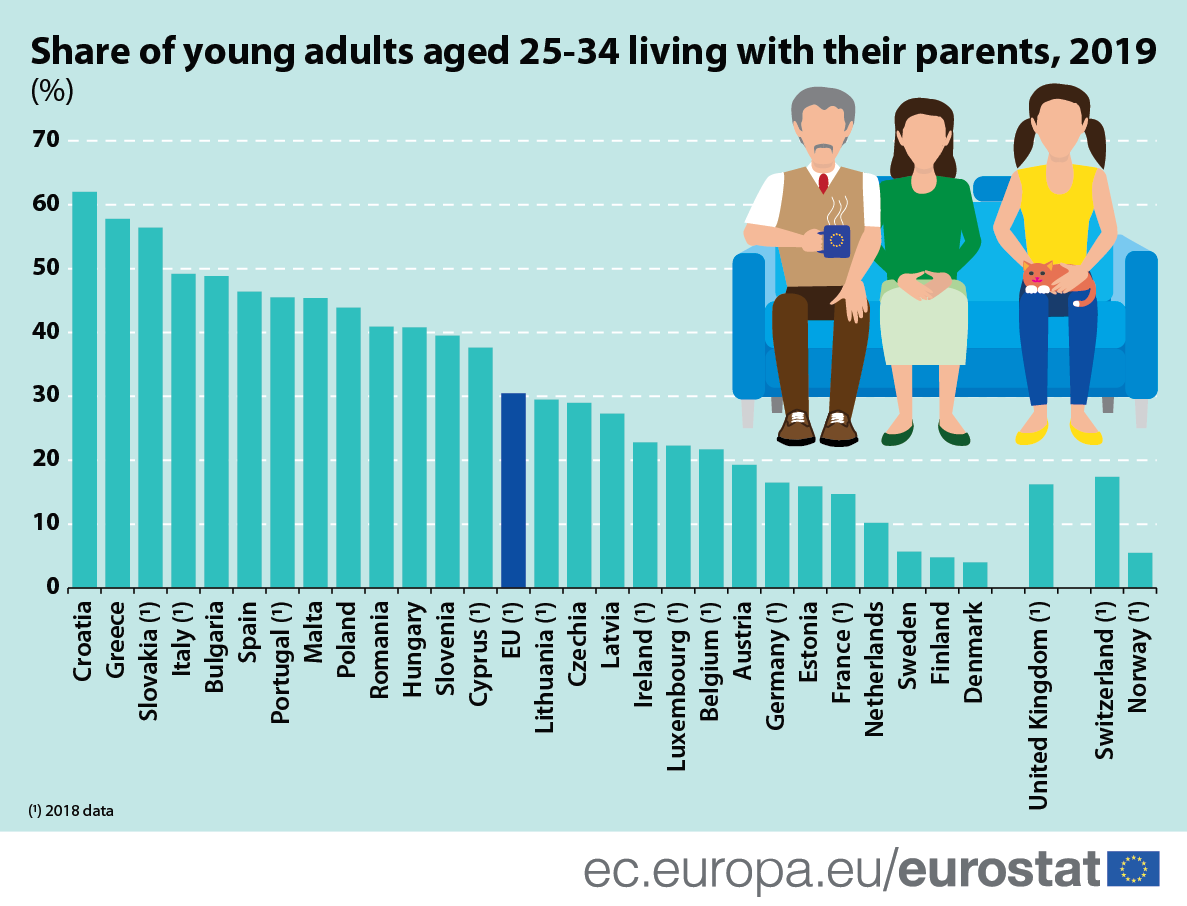

The FINANCIAL — In 2019, the share of young people aged 25 to 34 who were living with their parents ranged across the EU Member States from less than 10% in Denmark (4.0%), Finland (4.8%) and Sweden (5.7%), to more than half in Slovakia (56.4% in 2018), Greece (57.8%) and Croatia (62.0%).
Youngest people to fly out of the nest are in Sweden, Luxembourg, Denmark and Finland
Leaving the parental household is often affected by whether or not young people are in a relationship with partner or studying, their level of financial (in)dependence, labour market conditions, the affordability of housing but also cultural particularities. On average, young people in the EU left the parental household at the age of 26.2 years in 2019. However, this age varied significantly across the EU Member States.
In 2019, young people left home earliest in the three northern Member States – Sweden (17.8 years), Denmark (21.1 years) and Finland (21.8 years), as well as in Luxembourg (20.1 years). Young people also left home before the age of 25 in Estonia (22.2 years), France (23.6 years), Germany and the Netherlands (both with 23.7 years).
In the southern EU Member States young people move out at around 30
At the other side of the scale, young adults in Croatia and Slovakia remained the longest in the parental household. They left home on average at the age of 31.8 and 30.9 years respectively. Young adults in Italy (30.1 years), Bulgaria (30.0 years), Malta (29.9 years), Spain (29.5 years), Portugal (29.0 years) and Greece (28.9 years) also remained with their parents for longer.