

In my last few columns I discussed Georgian politics and what Georgians think and feel regarding neighbours or other countries’ key politicians. This week, I shift gears to explore where Georgia stands in this region in terms of media habits and in particular, internet and social media usage. Georgia is on the verge of huge changes and will soon join most developed counties and have super high speed internet access. But such an upgrade presents a unique opportunity whose benefits would not be limited to monetary gains. Georgia could complement this intensive service by facilitating increased smart phone ownership.
But to start to off, I am providing a picture of traditional and digital media usage in the ENPI region. The data presented below is derived from the EU Neighbourhood Barometer survey, which GORBI is overseeing in 6 countries as part of a larger consortia led by TNS Opinion SA (Kantar Media SA and Particip GmbH). Overall, the project is conducted on behalf of the European Commission’s Development and Cooperation Office, Europe Aid and covers 16 partner countries and territories participating in the European Neighbourhood policy, plus Russia.
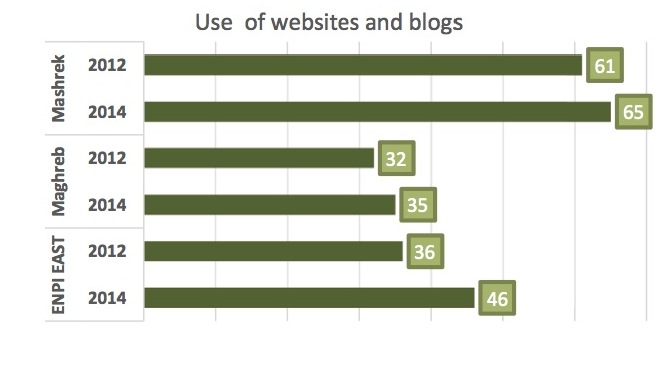
Last conducted in July 2014, the survey on media habits revealed in Georgia, internet usage is now reaching about 40%. Like all countries surveyed, it is increasing but at a very slow pace. The Chart 1 shows differences in usage of websites and blogs by three ENPI sub regions: East (Armenia, Azerbaijan, Belarus, Georgia, Moldova and Ukraine); Maghreb (Algeria, Libya, Morocco, Tunisia) and Mashrek (Israel, Jordan, Lebanon Palestine).
In particular, among citizens in the European Neighbourhood area, there is an increase in Internet use: in Mashrek, the percentage of citizens using the internet (65%, +4 points compared to 2012) and social networks (59%, +12) is higher than in the Maghreb (35%, +3 and 39%, +4 respectively). The same evolution has been registered in the Eastern Partnership countries: 46% use internet (+10 points compared to 2012) and 44% use social networks (+12).
Chart 1. Dynamics of usage of internet over the last 3 years
Source: EU Neighbourhood Barometer survey, 2014.
Chart 2. Georgia, usage of website and blogs by age groups

Source: EU Neighbourhood Barometer survey, 2014.
Respondents were also asked to what extent they use six different types of media, namely
television, radio, internet, online social networks, print media and internet television. Respondents in the Eastern Partnership countries are by far the most likely to watch television with 95% saying that they do so at least once a week. 46% say they listen to the radio or use the internet at least once a week, followed by 44% using online social networks.
The same question was also asked in spring 2012. In comparison to the results at that time, use of online media – be it the internet in general, online social networks or Internet-TV – has increased considerably, while fewer respondents now read the print media at least once a week.
Table 1: Media consumption among ENPI-East countries (Total usage: at least once a week)
|
|
|
|||||||
|
|
Watch television on a TV set |
Listen to the radio |
Use the internet |
Use online social network |
Read the printing press |
Watch TV via internet |
||
|
|
|
|
|
|
|
|
||
|
ENPI East |
95 |
46 |
46 |
44 |
38 |
19 |
||
|
96 |
16 |
41 |
45 |
27 |
16 |
|||
|
Ukraine |
97 |
51 |
45 |
43 |
38 |
16 |
||
|
Armenia |
93 |
21 |
53 |
49 |
16 |
33 |
||
|
Azerbaijan |
90 |
31 |
40 |
34 |
19 |
22 |
||
|
Belarus |
92 |
52 |
52 |
48 |
57 |
21 |
||
|
Moldova |
91 |
62 |
55 |
53 |
47 |
35 |
||
|
|
|
|||||||
|
Russia |
96 |
50 |
59 |
53 |
43 |
26 |
||
Source: EU Neighbourhood Barometer survey, 2014.
In all countries, nearly all respondents are watching television at least once a week. Some variation in usage patterns can be depicted regarding other media.
Television – 90% or more respondents in all countries report that they watch TV at least once a week;
Social media – Georgians rank this form of media second in terms of usage (45%);
Radio – Listening to radio receives the second highest number of mentions in Ukraine (51%) and Moldova (62%);
Internet is most likely to be mentioned as the second most used media place in the Russian Federation (59%), Armenia (53%) and Azerbaijan (40%);
Printed press came in second place in Belarus (57%).
The use of certain media is directly linked to respondents’ socio-demographic characteristics. Respondents’ age and level of education are the most discriminating factors. Young respondents are significantly more likely to use online media than their older counterparts. Conversely, the oldest age groups watch more television and read more printed press than younger groups. Well-educated respondents are more likely to use any forms of media, particularly online media, than respondents who have received less full-time education.
Regardless of the slow growth of internet penetration in Georgia, the country is catching up with TV usage in terms of importance for receiving information. As proven in scores of developing countries, increase in internet penetration is positively correlated to increase of economic growth and general knowledge level. More importantly, decline in global crime over the last decade is directly attributed to increased internet access. Attached to their PC screens more than ever, young people have less time or interest to go out onto the streets and expose themselves to crime or be lured into criminal groups.
In Georgia, GSM operators is soon expected to purchase a state-held licence for 4G Internet, which will allow us to enjoy much faster internet by the end of 2015. While this landmark deal will certainly provide a huge indirect boost to Georgia’s GDP, among other benefits, the government perhaps does not fully appreciate the opportunity this presents to the country. We could complement the introduction of super fast internet by learning from our Baltic peers. In the 1990s, the Baltic countries granted each citizen a one-time opportunity to purchase a PC VAT free. With smart phone penetration only around 19% in Georgia, the government could mirror such an initiative but with smart phones. This would not only facilitate more extensive internet use; it would help individual Georgian citizens better integrate their country with the global economy.
GORBI is a regional hub for partner organizations and international clients. Since 2003, GORBI remains an exclusive member of Gallup International research network for its two decades of experience in survey research in post-Soviet Union countries, as well as Mongolia and Iraq. All surveys were conducted on a national representative sample of 1,000 respondents; data retains a 3% margin of error, with confidence at 95%. This data was provided exclusively to the Financial. Please do not visit our site ( www.gorbi.com ); it is under construction.


