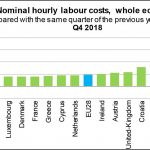

The FINANCIAL — Hourly labour costs rose by 2.3% in the euro area (EA19) and by 2.8% in the EU28 in the fourth quarter of 2018, compared with the same quarter of the previous year. In the third quarter of 2018, hourly labour costs increased by 2.5% and 2.6% respectively. These figures are published by Eurostat, the statistical office of the European Union.
The two main components of labour costs are wages & salaries and non-wage costs. In the euro area, the cost of wages & salaries per hour worked grew by 2.3% and the non-wage component by 2.4% in the fourth quarter of 2018 compared with the same quarter of the previous year. In the third quarter of 2018, the annual changes were +2.3% and +2.9% respectively. In the EU28, the costs of hourly wages & salaries rose by 3.0% and the non-wage component rose by 2.2% in the fourth quarter of 2018. In the third quarter of 2018, annual changes were +2.7% and +2.4% respectively.
Breakdown by economic activity
In the fourth quarter of 2018 compared with the same quarter of the previous year, hourly labour costs in the euro area rose by 1.9% in industry, by 2.4% in construction, by 2.5% in services and by 2.4% in the (mainly) non- business economy. In the EU28, labour costs per hour grew by 2.4% in industry, by 2.8% in construction and in services, and by 3.0% in the (mainly) non-business economy.
Member States
In the fourth quarter of 2018, the highest annual increases in hourly labour costs for the whole economy were registered in Romania (+13.1%), Latvia (+11.8%), Portugal (+10.3%), and Lithuania (+10.2%), while the only decrease was recorded in Malta (-0.5%).