
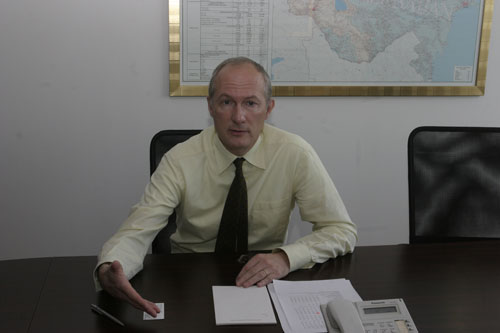

The FINANCIAL — “The Government has managed its external debt responsibly and the economic programme, which is supported by the IMF. It aims at containing and reducing Georgia’s foreign debt over the medium term. Therefore I believe that Georgia’s foreign debt is not an obstacle to attracting foreign investors,” Edward H. Gardner, Senior Resident Representative for the Middle East and Central Asia Department, told The FINANCIAL. He believes the growth that took place in 2007 with 12% GDP growth isn’t likely to reoccur soon.
“As all countries that have experienced the crisis, Georgia borrowed abroad to make up for the lack of private capital inflows of the last couple of years, so debt has increased. But that has been a normal response to the crisis.
“One of the advantages is that Georgia started out with relatively low debt, so it could afford to take on new debt; the challenge is to reverse the process of debt accumulation. The reduction in the government deficits targeted for by 2011 and beyond should lead to a gradual decline in external public debt (in percentage of GDP) starting in 2012, from a peak of around 38 percent in 2011.
“Of course, as the Government runs the deficit it has to continue borrowing, some of it externally. However, with the economy growing, we should see the ratio of debt to GDP coming down.
“IMF projects 4.5% growth of GDP in 2011 for Georgia. Realization of this rate of GDP growth in Georgia will mainly depend on the private sector recovering strongly (both in terms of investment and household consumption) as the Government gradually withdraws its fiscal stimulus.
IMF loans (with 3.5% interest) are due to be repaid starting in 2011 with a small amount; whilst most of IMF loans are to be repaid in 2012-2014 with a peak in 2013.
“In addition there is roughly another 250 million USD of loan (with 3.5% interest) available to the Government and the central bank from IMF in 2011.”
Q. What is the overall size of loans that IMF (Int. Monetary Fund) has provided to Georgia since 2008 and what are the interest rates charged on them?
A. Total IMF loan to Georgia under the Stand-By Arrangement is around 1,155 million USD. As of today 892 million USD has been disbursed.
The loan carries a floating interest rate and it’s about 3.5% at present.
Q. When does the Government have to repay the loans borrowed, is it conditions based? And is borrowing limited to the Government from the IMF?
A. IMF loans are being repaid starting in 2011 in small amounts; whilst most of IMF loans are to be repaid in 2012-2014 with a peak in 2013.
From the IMF, the borrowing is done by the Government and the central bank; so we look at it as a package. There is roughly another 250 million USD available to the Government and the central bank in 2011. Georgia will be able to draw this amount in two remaining tranches once we have assessed that the programme is on track. The next programme review, which will assess performance relative to the December 2010 targets, is scheduled for next week, and upon its completion about 150 million USD would become available to Georgia.
Q. What about the average projected 6% GDP growth in 2011, how viable is it?
A. Actually for 2011 we’re conservatively projecting GDP of 4.5%, with the understanding that the figure may vary and could be higher.
Realization of this rate of GDP growth in Georgia mainly depends on the private sector recovering strongly (both in terms of investment and household consumption) as the Government gradually withdraws its fiscal stimulus.
Q. Are we likely to go back to the 12% growth that was in 2007 any time soon?
A. The growth that took place in 2007 with 12% GDP growth isn’t likely to reoccur soon. The growth in those years by all accounts was excessive, and overheating led to both inflation and very large external deficits; in the period after 2003, there was also a healthy catch up from a low base, of course, which was enabled by the economic reforms pursued by the Government.
This rapid growth was financed in large part by large inflows of capital from abroad. Going forward, in the near term, we don’t see private capital flows growing quite so rapidly again.
This said, there’s every reason to believe that Georgia will grow at a very solid rate going forward, certainly in line if not better than the average of developing and emerging markets.
Conditions for strong growth are there, both in terms of the business environment and in terms of sound macroeconomic management by the Government and the central bank. Right now the government deficit is being reduced very rapidly to minimize the risks of excessive indebtedness, and the central bank has done a very good job in managing the financial instability that was caused by the crisis. Overall, the ingredients for strong growth are there.
Q. Has the Georgian economy recovered from the repercussions of the war with Russia in August 2008?
A. In terms of the direct impact of the war, the economy has recovered. The problem is that the war was a shock to confidence and I think foreign investors slowly are coming to the conclusion that Georgia is back in business as a place to work and invest.
All in all I would say yes, but the process is still ongoing and the picture is a bit mixed: FDI has not come back as we hoped; it is still hesitant.
At the same time, Georgia is able to attract other forms of capital, such as non-resident depositors putting money in Georgia, enterprises and banks borrowing abroad, etc. And rating upgrades in 2010 also put the Government in a good position to go back to the market. So all in all there is good evidence that people are willing to put money in Georgia although not necessarily in the same fashion that they were used to doing before.
Q. How about the interest rates charged on loans, is it likely to come down in the long term? As we are seeing a trend of it coming down?
Georgia joined the Fund on May 5, 1992
Quota: SDR 150.30 million
A. Interest rates are admittedly quite high in Georgia.
We expect in time the interest rates coming down, but generally the reason why interest rates are so high is, first, that the cost of funding is high, and second that on top of that banks have to charge rates that cover a number of risks. Apart from the credit risk of the specific borrowers, banks face other uncertainties and risks, for instance in terms of future inflation and the future cost of funds.
Q. But is it likely that interest rates were radically coming down?
A. It is not unreasonable in emerging markets to see real rates of interest (that is interest rates after inflation) in the 5-10 percent range, which would be the real rate of return from an investment that you would need to repay the loan.
In Georgia, to calculate the real rate of interest we should subtract the inflation rate projected for 2011, that is around 6 percent. Therefore, subtracting 6 percent from current lending rates, you would probably need a real rate of return of around 10 percent or more to justify borrowing for a project.
Q. Comparing the crisis and recovery in Georgia with borrowing with other parts of the region, what is the situation out there?
A. There are many similarities to other countries in the region. The shock has been pretty much the same everywhere, although in Georgia it was compounded by the war and the loss of confidence which came with it.
Georgia suffered a much bigger contraction of bank credit and FDI than most other countries. However Georgia was also able to run a bigger government deficit than many countries because it had more financing and it had less debt to begin with. As a result, the economy contraction was much less severe than in many other countries, such as Ukraine and Armenia for example (and some other developing countries). Right now, the recovery in Georgia is roughly on par with that of other countries.
Q. How about the private sector investment, has it boosted since the war?
A. It’s hard to have very definite statistics on private sector investment but looking at the financing side (FDI and credit), it is clear that private investment took a big hit in 2009. There are signs that it began recovering in 2010, supported by renewed growth in credit and FDI. In part the recovery in bank credit probably went to help enterprises rebuild inventories.
Q. Talking about FDI, what steps can the Government take to restore investors’ confidence?
A. The Government is taking all the right steps; you can’t force FDI but only create a propitious environment for it. On that score, the Government has used well the foreign financing that was made available after the crisis to improve infrastructure, rather than to increase less productive current spending. Such spending will make the investment environment more attractive.
In addition to all the reforms designed to improve the business climate, the Government’s focus on preserving macroeconomic stability is also crucial to restoring confidence: by reducing its deficit, rebuilding the international reserves of the central bank, and allowing the exchange rate to move more flexibly, the Government is making sure that the country does not accumulate imbalances that could lead to future crises.
Q. What about the bank loans which were denominated mainly in USD? Has it changed to GEL?
A. Bank loans are still mostly in USD, there was some increase in GEL denominated lending in the first half of 2010; but more lately USD denominated loans have grown faster.
The currency denomination of loans reflects the choice that banks and customers make; and it’s important for the national bank to influence that choice through its policies, including prudential policies; but ultimately in a liberal system like Georgia’s, the currency in which loans are denominated reflects the free interactions of depositors, banks and borrowers.
Here it is important to stress that, as the National Bank of Georgia has been advocating, there are risks to borrowing in USD. For most borrowers whose income is in GEL, a USD loan (even at a lower interest rate) carries very significant risks of seeing the debt burden increase if the exchange rate depreciates. For this reason, the National Bank rightly requires that banks put up more capital when they lend in USD, which in turn increases the cost of USD loans. This is one way, certainly preferable to outright prohibition, in which the National Bank is trying to influence the free choices of the public and of banks.
Q. Would you advise the Government to borrow more funds from outside?
A. The Government should, as it’s doing, reduce its deficit next year to around 4% of the GDP which is quite a large strong reduction from 2010. The lower deficit will reduce the borrowing requirement, but given the limited scope for domestic borrowing, external borrowing will continue to play an important role, even as the deficit is brought down to under 3 percent of GDP by 2013, as targeted by the Government.


