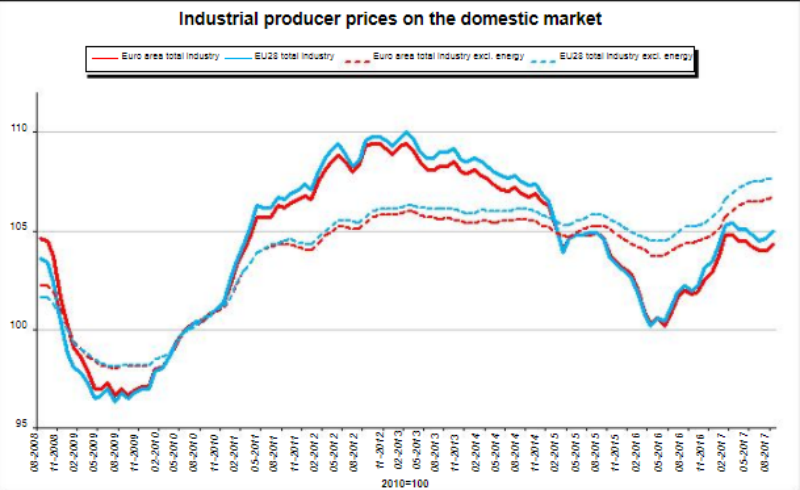

The FINANCIAL — In August 2017, compared with July 2017, industrial producer prices rose by 0.3% in the euro area (EA19) and by 0.4% in the EU28, according to estimates from Eurostat, the statistical office of the European Union.
In July 2017, prices remained stable in the euro area and increased by 0.1% in the EU28.
In August 2017, compared with August 2016, industrial producer prices rose by 2.5% in the euro area and by 2.9% in the EU28.
Monthly comparison by main industrial grouping and by Member State
The 0.3% increase in industrial producer prices in total industry in the euro area in August 2017, compared with July 2017, is due to rises of 0.7% in the energy sector, of 0.2% for intermediate goods and of 0.1% for both durable and non-durable consumer goods, while prices remained stable for capital goods. Prices in total industry excluding energy rose by 0.1%.
In the EU28, the 0.4% increase is due to rises of 1.1% in the energy sector, of 0.2% for intermediate goods and of 0.1% for capital goods, durable and non-durable consumer goods. Prices in total industry excluding energy rose by 0.1%.
The highest increases in industrial producer prices were observed in Hungary, Slovakia and the United Kingdom (all +0.9%) as well as in Belgium (+0.8%), while a price decrease was observed in Sweden (-0.2%).
Annual comparison by main industrial grouping and by Member State
The 2.5% increase in industrial producer prices in total industry in the euro area in August 2017, compared with August 2016, is due to rises of 3.4% in the energy sector, of 3.0% for intermediate goods, of 2.5% for non-durable consumer goods, of 1.0% for capital goods and of 0.5% for durable consumer goods. Prices in total industry excluding energy rose by 2.2%.
In the EU28, the 2.9% price increase is due to rises of 4.6% in the energy sector, of 3.1% for intermediate goods, of 2.8% for non-durable consumer goods, of 1.1% for capital goods and of 0.9% for durable consumer goods. Prices in total industry excluding energy rose by 2.4%.
Industrial producer prices rose in all Member States. The largest increases were recorded in Belgium (+7.2%), Bulgaria (+5.9%), Estonia (+5.7%) and the United Kingdom (+5.1%).