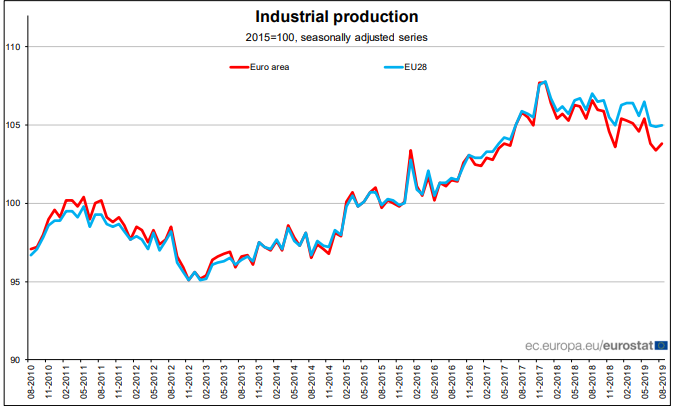

In August 2019 compared with July 2019, seasonally adjusted industrial production rose by 0.4% in the euro area (EA19) and by 0.1% in the EU28, according to estimates from Eurostat, the statistical office of the European Union. In July 2019, industrial production fell by 0.4% in the euro area and by 0.1% in the EU28.
In August 2019 compared with August 2018, industrial production decreased by 2.8% in the euro area and by 2.0% in the EU28.
Monthly comparison by main industrial grouping and by Member State
In the euro area in August 2019, compared with July 2019, production of capital goods rose by 1.2% and intermediate goods by 0.3%, while production of non-durable consumer goods fell by 0.3%, and durable consumer goods and energy by 0,4%.
In the EU28, production of capital goods rose by 0.8% and intermediate goods by 0.2%, while production of durable consumer goods fell by 0.5%, and energy and non-durable consumer goods by 0.6%. Among Member States for which data are available, the highest increases in industrial production were registered in Malta (+5.6%), Estonia (+3.9%) and Latvia (+3.0%). The largest decreases were observed in Croatia (-3.0%), Slovakia (-2.6%) and Lithuania (-2.4%).
Annual comparison by main industrial grouping and by Member State
In the euro area in August 2019, compared with August 2018, production of non-durable consumer goods fell by 2.0%, capital goods by 2.9%, intermediate goods by 3.1% and energy by 3.3%, while production of durable consumer goods rose by 0.4%.
In the EU28, production of non-durable consumer goods fell by 0.4%, intermediate goods by 2.3%, capital goods by 2.6% and energy by 3.0%, while production of durable consumer goods rose by 0.8%.
Among Member States for which data are available, the largest decreases in industrial production were registered in Slovakia (-8.1%), Ireland (-6.2%) and Romania (-6.1%). The highest increases were observed in Malta (+7.4%), Denmark (+6.6%) and Finland (+4.5%)