
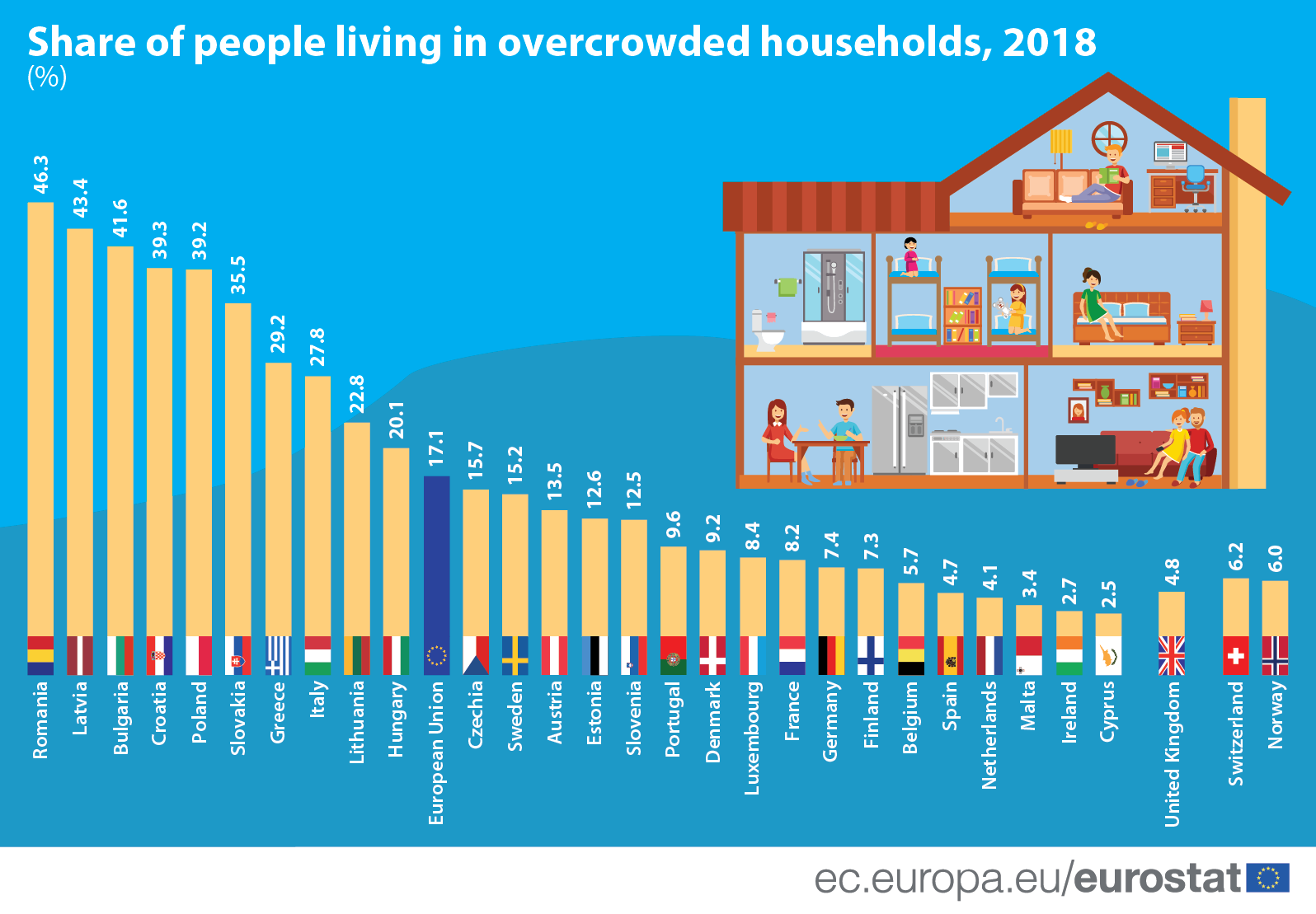

The FINANCIAL – In the European Union (EU), 17.1% of the population were living in overcrowded households in 2018, meaning they did not have enough rooms compared to the size of the household. Although merrier, overcrowded households can feel even smaller with kids playing in the same room as parents trying to telework during the coronavirus lockdown. Moreover, overcrowded environments can present a higher risk of spreading the virus.
On the other hand, staying home alone for days on end brings its own set of challenges as well. In the EU, more than one in three persons (33.0%) lived in under-occupied dwellings in 2018, meaning that the dwellings were deemed to be too large, in terms of excess rooms and more specifically bedrooms, for the needs of the household living in it.
Overcrowding rate falling slightly in countries with the highest rates
Among the EU Member States, almost half the population in Romania (46.3%) were living in overcrowded households in 2018. This was also the case for around two in every five persons in Latvia (43.4%), Bulgaria (41.6%), Croatia (39.3%) and Poland (39.2%). Compared to the previous year, the share of the population living in overcrowded dwellings fell slightly in all of these countries except Latvia (+1.5 percentage points), with the strongest fall recorded in Poland (-1.3 pp).
At the opposite end of the scale, the lowest overcrowding rates were recorded in Cyprus (2.5%), Ireland (2.7%), Malta (3.4%) and the Netherlands (4.1%).
The share of young people and children that live in overcrowded dwellings is much higher than for the elderly. In 2018, almost one quarter (24.1%) of people aged 18 year or less lived in overcrowded dwellings in the EU, while only 6.9% of those aged 65 years and older did. In particular, 40.2% of young people in the EU who were living in households at risk of poverty were also living in overcrowded dwellings.
Seven in ten persons living in under-occupied dwellings in Malta, Ireland and Cyprus
In 2018, almost three quarters of the population were living in under-occupied dwellings in Malta (73.4%), Ireland and Cyprus (both 71.4%). In Belgium (58.6%), Spain (56.3%), the Netherlands (53.9%) and Luxembourg (53.7%), more than half of the population were living in dwellings deemed too large. From 2017 to 2018, the largest drops in share of the population living in under-occupied dwellings were recorded in Luxembourg (-1.8 percentage points), Denmark (-1.7 pp) and Sweden (-1.0 pp).
In contrast, less than 15% of the population were living in dwellings deemed to be too large in Romania (7.3%), Latvia (9.9%), Greece (10.4%), Bulgaria (11.5%), Croatia (11.6%), Slovakia (12.7%), Poland (14.4%) and Italy (14.9%).
Close to half of the people aged 65 year or older (46.9%) in the EU were living in under-occupied dwellings in 2018. This was the case for a vast majority of elderly people in Ireland (92.8%), Cyprus (87.4%) and Malta (86.7%), while relatively few elderly lived in dwellings with too many rooms in Romania (12.0%), Latvia (13.3%), Croatia (16.9%) and Poland (17.8%).


