
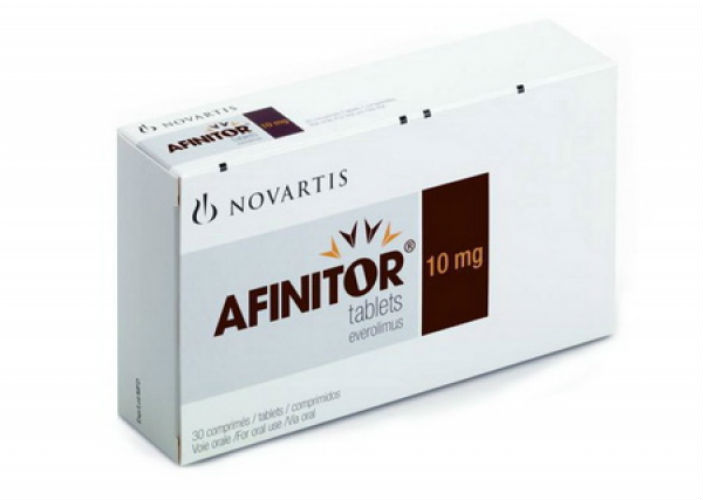

The FINANCIAL — Novartis announced on June 2 that the European Commission has approved Afinitor (everolimus) tablets for the treatment of unresectable or metastatic, well-differentiated (Grade 1 or Grade 2) nonfunctional neuroendocrine tumors (NET) of gastrointestinal (GI) or lung origin in adults with progressive disease. Afinitor is the first approved therapy in all 28 member states of the European Union (EU), plus Iceland and Norway, for this type of lung NET, and one of very few treatment options available for this type of GI NET.
“With this decision, Afinitor is now approved in the EU to treat the three most common types of advanced NET,” said Bruno Strigini, President, Novartis Oncology. “As a company that has long been dedicated to advancing care for NET patients, we are pleased that this latest milestone makes Afinitor available to patients in the EU who previously had few or no approved treatment options.”
Neuroendocrine tumors are a type of cancer that originate in neuroendocrine cells throughout the body, and most commonly arise in the GI tract, lungs or pancreas. NET can be defined as functional or nonfunctional. The majority of patients with NET (72%) have nonfunctional NET, which are characterized by symptoms caused by tumor growth, such as intestinal obstruction, pain and bleeding for GI NET, and asthma, chronic obstructive pulmonary disease and pneumonia for lung NET. In contrast, functional NET are characterized by symptoms caused by the oversecretion of hormones and other substances. Five to 44% (depending on site of tumor origin) of those with GI NET and 28% of those with lung NET have advanced disease at time of diagnosis, meaning the cancer has spread to other areas of the body, and patients face limited treatment options. Progression, or the continued growth or spread of the tumor, is typically associated with poor prognoses, according to Novartis.
The EU approval of Afinitor was based on efficacy and safety data from a pivotal Phase III study (RADIANT-4) evaluating Afinitor versus placebo in patients with advanced, progressive, well-differentiated nonfunctional NET of GI or lung origin. Results showed that Afinitor reduced the risk of disease progression by 52% (hazard ratio = 0.48; 95% confidence interval [CI], 0.35-0.67; p<0.00001) compared to placebo. The data also showed Afinitor increased median progression-free survival (PFS) by 7.1 months: median PFS by central review was 11.0 months (95% CI, 9.2-13.3) in the Afinitor arm and 3.9 months (95% CI, 3.6-7.4) in the placebo arm.
In the pivotal trial, the most common treatment-related, all-grade adverse events (AEs) (incidence >=20%) for Afinitor and placebo, respectively, were stomatitis (63% vs 19%), diarrhea (31% vs 16%), fatigue (31% vs 24%), infections (29% vs 4%), rash (27% vs 8%) and peripheral edema (26% vs 4%). The most common treatment-related grade 3/4 AEs (incidence >=5%) for Afinitor versus placebo were stomatitis (9.0% vs 0.0%), diarrhea (7.0% vs 2.0%) and infections (7.0% vs 0.0%).
In February 2016, the US Food and Drug Administration approved Afinitor for the treatment of adult patients with progressive, well-differentiated nonfunctional NET of GI or lung origin that are unresectable, locally advanced or metastatic. In April 2016, the Committee for Medicinal Products for Human Use (CHMP) of the European Medicines Agency (EMA) adopted a positive opinion for Afinitor tablets for the treatment of unresectable or metastatic, well-differentiated (Grade 1 or Grade 2) nonfunctional NET of GI or lung origin in adults with progressive disease. Afinitor received approval for this indication in Canada in May 2016, and additional worldwide regulatory filings are underway.


