
The FINANCIAL – IMF team reaches a staff level agreement with the Georgian authorities for the completion of the Sixth Review and an augmentation of access under the Extended Fund Facility. Pending the Executive Board approval, about $200 million will be made available immediately to the budget to help Georgia cope with the COVID-19 pandemic.
Higher IMF financing will help meet urgent medical and socio-economic needs, secure other donor funding, and support the recovery.
The authorities have taken decisive steps to contain the COVID-19 pandemic and limit its economic impact.
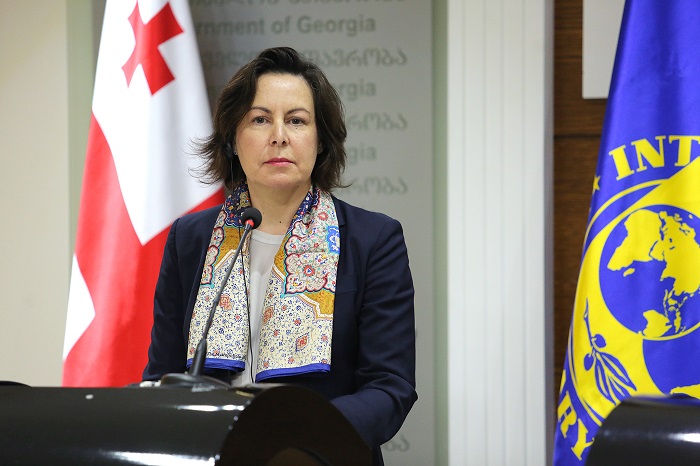
An International Monetary Fund (IMF) team led by Mercedes Vera Martin conducted discussions on the Sixth Review and on augmentation of access under the Extended Fund Facility (EFF) during April 1-13, 2020.
IMF Coronavirus – Economic Cost Difficult to Predict
IMF is “ready to deploy all US$1 trillion lending capacity” to save members
“Following productive discussions, the Georgian authorities and the IMF team reached a staff-level agreement on the conclusion of the Sixth Review of the EFF arrangement. The team will also recommend an increase in IMF support to Georgia by 130 percent of the quota (about $375 million) to help finance health and macroeconomic stabilization measures, meet urgent balance of payments needs arising from the COVID-19 pandemic, and catalyze support from the international community. The disbursement associated with this review (about $200 million) will be allocated for budget support to help the authorities meet urgent medical and socio-economic needs, to be disbursed with the completion of this review.
“The agreement is subject to approval by the Executive Board. Consideration by the Executive Board is expected in early May. With the financing available to Georgia upon completion of the review, total disbursements under the EFF arrangement will amount to 155 percent of quota (at about $450 million)”, Ms. Vera Martin stated..
“With the Covid-19 pandemic, Georgia’s economic outlook has significantly deteriorated. Real GDP is expected to decline by 4 percent in 2020, although projections are subject to more than the usual uncertainty. Deteriorating trade, halted tourism, and weaker remittances are expected to widen the current account deficit to 11⅓ percent of GDP in 2020. Rising global risk aversion is likely to reduce private financial inflows and delay investment. Urgent balance-of-payments needs raising from the Covid-19 shock are estimated at about $1.6 billion in 2020-21, to be financed by IMF financing and other donor assistance.
“The authorities have taken decisive steps to contain the COVID-19 pandemic and limit its economic impact. Prudent macroeconomic policies, the buildup of fiscal and foreign exchange reserves in recent years, a well-capitalized financial system, and significant financial donor support make the Georgian economy prepared to address the shock.
“The fiscal deficit is expected to temporarily widen to 8½ percent of GDP in 2020, as revenues decline and spending rises to contain the virus outbreak and offset the social and economic impact of the pandemic. The authorities have mobilized financing from the IMF and other international partners to finance the deficit and build buffers that would allow for additional policy space if downside risks materialize. Once the shock is over, the authorities are committed to fiscal consolidation and to build buffers for fiscal risks.
“Within its mandate of price and financial stability, the National Bank of Georgia (NBG) has intervened in the foreign-exchange market to smooth exchange rate volatility, and taken decisive steps to safeguard financial stability. Capital and liquidity buffers have been promptly released to support the economy, while banks have been asked to recognize losses promptly. The NBG stands ready to adjust policies as needed to support price stability and preserve financial stability.
“Advancing structural reforms will help sustain medium-term growth potential and help achieve a faster recovery after the COVID-19 pandemic. The authorities should implement promptly a new corporate insolvency framework. Adopting an indexation rule for the basic public pension will help improve the real income for pensioners and reduce old-age poverty.
“The IMF team would like to thank the authorities, our international development partners, and representatives of the private sector, for the open and constructive discussions,”Ms. Vera Martin stated.
IMF is “ready to deploy all US$1 trillion lending capacity” to save members