
Background on Eurasian Economic Union (EAEU)
EAEU provides for free movement of goods, services, capital and labor for its five members: Armenia, Belarus, Kazakhstan, Kyrgyzstan, and Russia.
Monetary and fiscal policy is managed individually by each member states, with active information exchange but no coordination or joint decision making.
Russia is the largest economy in the union, representing about 87% of economic activity. Kazakhstan is a distant second with 9% and Belarus is third with about 3%. Armenia and Kyrgyzstan together make up about 1% of economic activity within the union.
Russia is a leading trading partner and significant source of remittance and investment flows within EAEU. Therefore, developments in Russia have a major impact on EAEU members.
Eurasian Economic Union countries are exposed to shocks from Russia
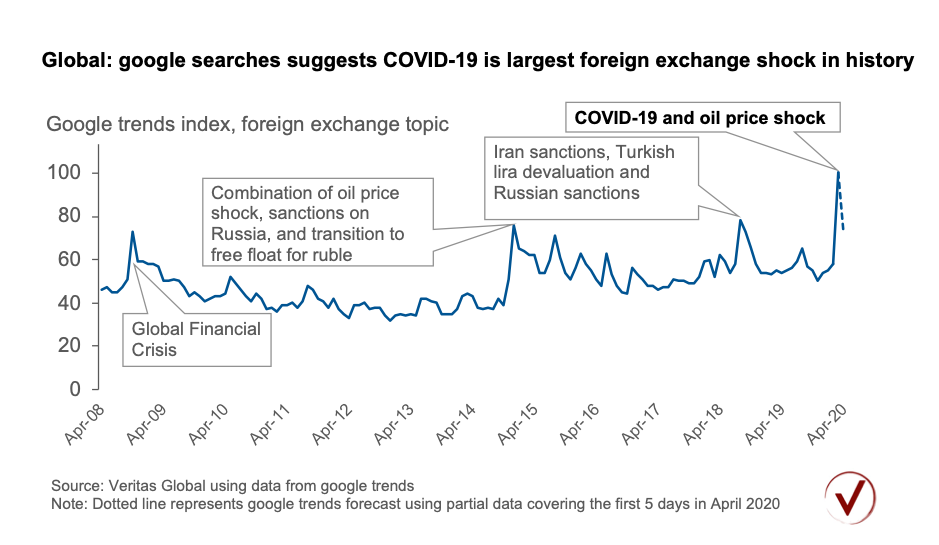
Countries in the EAEU have historically, over the past 12 years, had some of the highest rates of google searches[i] on the topic of “foreign exchange”, which points to rising exchange rate pressures. This was also observed following the outbreak of COVID-19 (see our related analysis: Spike in “foreign exchange” google search after COVID).
Exposure of EAEU members to Russia shocks, including oil price, geopolitical instability, armed conflict and sanctions, can be seen through the synchronized movements in the rate of google searches on the topic of “foreign exchange” (see chart: Eurasian Economic Union). The heightened volatility has been harmful to all EAEU members, but especially damaging to oil importing countries without reserves to cushion impacts.
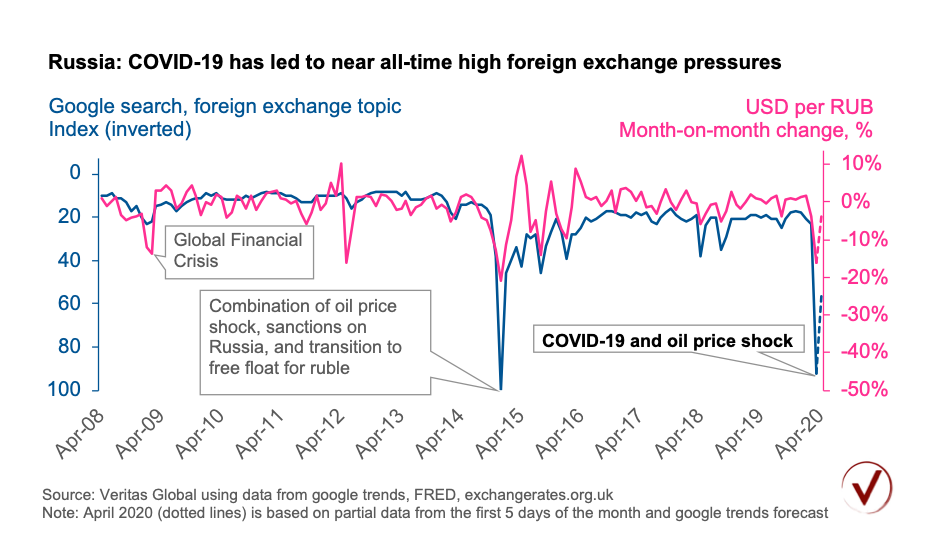
Over the past 12 years, the Russian ruble depreciated significantly against the US dollar, losing over 228% in value (in nominal terms) and falling by as much as 21% and 16% in some months.
Russian ruble volatility likely to persist given reliance on oil and current monetary policy
Russian dependence on oil and gas revenue combined with a monetary policy that is not focused on exchange rate stability, point to factors that would likely lead to continued Russia ruble volatility against foreign currencies. Exposing EAEU members to future potential shocks.
Furthermore, Russian measures to support domestic demand may only create limited benefits for EAEU partners and lead to reinforcing socioeconomic disparities within the union. This is likely to be a major issue in light of the scale of the COVID-19 crisis.
The chart below (see chart: Russia) shows that google searches in Russia under the topic of “foreign exchange” have reached near an all-time high in March 2020. The search rate was higher only in December 2014, a time when Russia transitioned to a free-floating exchange rate and was facing a number of external pressures. It is worth noting that the google trends index correlates fairly well with ruble volatility against US dollar (correlations of over 0.5). Meaning when a larger share of google users perform searches that fall within the topic of “foreign exchange”, more volatility can also be observed in the US dollar to Russian ruble exchange.
Fiscal transfers or diversifying economic activity away from Russia can reduce vulnerabilities
Russia has foreign exchange buffers needed to smooth volatility arising from the COVID-19 crisis (see our related analysis: Russian economy COVID-19 stress test). However, its announced and potential future stimulus measures are unlikely to adequately support demand in EAEU countries, especially due to new barriers on trade, supply chain disruptions, and difficulties with labor mobility caused by the COVID-19 crisis.
To cushion the impact of volatility, Russia could provide direct fiscal transfers across EAEU countries. Over the medium term, the EAEU may need to develop mechanisms to systematically help smooth volatility across all countries to ensure cohesion within the union.
In the absence of direct fiscal transfers, EAEU countries should diversify economic activity away from “Russia risk” and associated vulnerabilities. Greater diversification will help reduce exposure to volatility emanating from Russia and have the added benefit of improved resilience to future shocks. The design of structural adjustment programs in response to the COVID-19 crisis should take this into consideration.